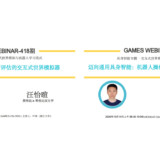
GAMES Webinar 2026 – 418期(迈向通用具身智能:交互式世界模拟与机器人学习范式)|汪怡暄(英伟达 & 哥伦比亚大学),郝策(北京中关村学院)
GAMES Webinar 2026 – 418期(迈向通用具身智能:交互式世界模拟与机器人学习范式)
报告嘉宾:汪怡暄(英伟达 & 哥伦比亚大学)
报告时间:2026年10月15日 早上09:00-09:30(北京时间)
报告题目:
Interactive World Simulator for Robot Policy Training and Evaluation
报告摘要:
Training and evaluating robot policies requires extensive real-world interaction, which is costly and difficult to scale. This talk introduces Interactive World Simulator (IWS), an action-conditioned world model learned from robot interaction data. By applying consistency models to image decoding and latent-space dynamics prediction, IWS enables stable interaction for over 10 minutes at 15 frames per second on a single RTX 4090 GPU. Across manipulation tasks involving rigid objects, deformable objects, and object piles, IWS supports demonstration generation for imitation learning and reproducible closed-loop policy evaluation. Experiments show that, on the evaluated tasks, policies trained on simulator-generated demonstrations achieve performance comparable to those trained on an equal amount of real-world data, while policy evaluation results in the simulator correlate strongly with real-world robot performance.
Yixuan Wang is a Research Scientist at NVIDIA’s Seattle Robotics Lab. He received his Ph.D. in Computer Science from Columbia University, advised by Prof. Yunzhu Li, his M.S. from the University of Illinois Urbana-Champaign, and his B.S. degrees from the University of Michigan and Shanghai Jiao Tong University. His research focuses on using foundation models for robotic interaction and building foundation models from robotic interactions. His work has received the ICRA Best Conference Paper Award and multiple workshop Best Paper Awards, and has been selected as a CoRL Best Paper Award finalist. He was also a Qualcomm Innovation Fellowship finalist.
报告嘉宾:郝策 北京中关村学院
报告时间:2026年10月15日 早上09:30-10:00(北京时间)
报告题目:
Towards General-Purpose Embodied Intelligence: Learning Paradigms for Robotic Manipulation and Legged Locomotion
报告摘要:
Enabling robots to manipulate objects dexterously and move robustly in complex, dynamic environments represents two fundamental challenges toward general-purpose embodied intelligence. This talk presents our recent research on robot learning along two complementary directions: robotic manipulation and legged locomotion. For robotic manipulation, we discuss policy learning approaches based on diffusion models (Diffusion Policy), vision-language-action (VLA) models, and force/tactile feedback, as well as skill abstraction and mixture-of-experts architectures for long-horizon and multi-task manipulation. For legged locomotion, we introduce our research on dynamic environment perception, reflexive obstacle avoidance, and motion control for quadrupedal and humanoid robots. Finally, we discuss the shared challenges of robotic manipulation and locomotion in perception, decision-making, and learning, and explore future directions toward unified learning paradigms for general-purpose embodied intelligence.
Ce Hao is a Researcher at Zhongguancun Academy. He received his Ph.D. in Computer Science from the National University of Singapore, advised by Prof. Harold Soh. Prior to that, he conducted research at the University of California, Berkeley, under the supervision of Prof. Masayoshi Tomizuka. He received his B.S. and M.S. degrees from Beihang University. His research focuses on embodied intelligence and robot learning, particularly generative policies for robotic manipulation, vision-language-action models, multimodal perception, skill learning, and dynamic locomotion control for quadrupedal and humanoid robots. He has published over 30 papers in leading robotics and artificial intelligence conferences and journals, including ICRA, CoRL, NeurIPS, ICLR, and IEEE RA-L.
讲者主页:https://cehao1.github.io/
主持人简介: